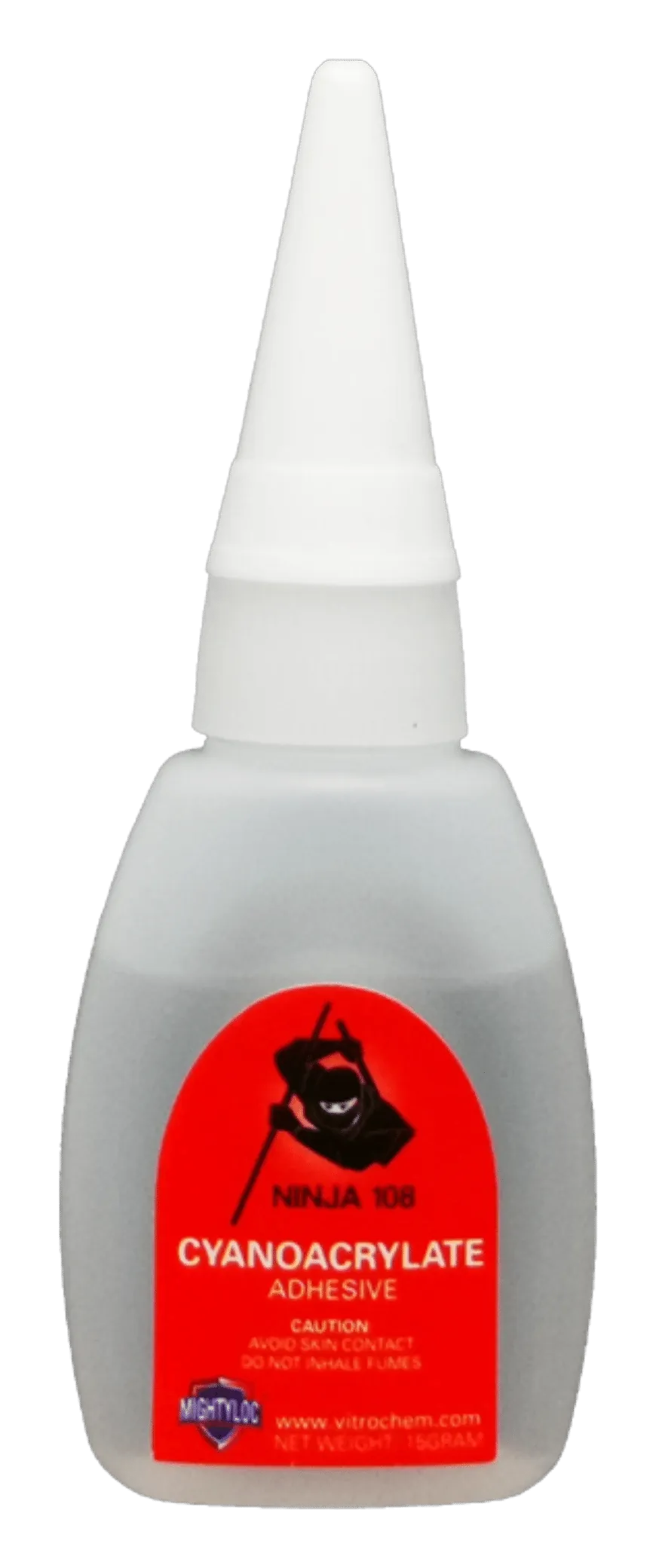
Cyanoacrylate is a one-part instant adhesive that cures in seconds when it is pressed into a thin film between two close-fitting parts, set off by the trace moisture on their surfaces. MightyLoc’s grade, Ninja 108, is an ethyl cyanoacrylate that fixtures in 3 to 20 seconds at 21 °C depending on the substrate, fills gaps up to 0.1 mm and is rated for continuous service from -50 to 80 °C. It is made for fast bonding of plastics, rubbers and other small, close-fitting parts, not for structural loads, wide gaps or hot service. The grade’s values are also on the cyanoacrylate page.
What is cyanoacrylate adhesive?
Cyanoacrylates are liquid monomers, esters of 2-cyanoacrylic acid, that polymerise very fast into a hard, clear thermoplastic. The family is named after the ester group: ethyl cyanoacrylate is the general-purpose grade used across industry, while methyl grades are often chosen for metals and alkoxy grades for low odour and low blooming. MightyLoc supplies one cyanoacrylate, MightyLoc Ninja 108, which its datasheet describes as an ethyl cyanoacrylate formulated for high-speed, high-strength bonding of plastics and rubbers.
In the trade it is called instant adhesive or CA. Outside industry the same chemistry is known as super glue. What sets an industrial grade apart is its stated viscosity, cure speed, gap limit and temperature range: those are the numbers to design with.
There is nothing to mix and no solvent to flash off. An acid stabiliser keeps the liquid stable in the bottle; spread thin on a surface, the stabiliser is overwhelmed and the cure starts.
How does cyanoacrylate cure?
Cyanoacrylate cures by anionic polymerisation. Weak bases start the reaction, and the commonest one is the film of adsorbed moisture found on almost every surface in normal air. A thin film turns solid in seconds. MightyLoc’s Ninja 108 datasheet puts it plainly: cyanoacrylates need surface moisture on the substrates to start the cure.
Three things follow from that mechanism:
- The bond line has to be thin. The cure starts at the two surfaces and works inward. In a thin film the whole layer is close to a surface and cures fast; in a wide joint the middle of the film cures slowly or stays liquid. That is why Ninja 108 is rated for gaps up to 0.1 mm only.
- The surface sets the speed. Neutral and basic surfaces start the cure quickly; acidic surfaces slow it, because they reinforce the stabiliser. The datasheet says acidic surfaces such as paper and leather cure more slowly than most plastics and rubbers.
- The air sets the speed too. The datasheet says low humidity and low temperature both reduce cure speed, and every cure figure it gives is measured at 21 °C.
The datasheet’s typical speeds show the spread: under 5 seconds rubber to rubber, under 10 seconds ABS to ABS and under 20 seconds steel to steel, all at 21 °C. Full cure takes 24 hours. The cure-time guide sets Ninja 108 beside MightyLoc’s other chemistries.
An activator, also called an accelerator, is a basic solution applied to one surface before bonding. The datasheet says activators may be required where there are gaps or porous surfaces. MightyLoc names no activator, so ask which one suits your parts.
What does cyanoacrylate bond, and what does it not?
MightyLoc Ninja 108 is formulated for plastics and rubbers, bonded to themselves or to other common substrates. MightyLoc’s General Brochure also names metals, wood, glass, fibreglass and composites for it. It lists picture-frame edge bonding among its applications. In practice it suits:
- small plastic and rubber parts, such as moulded components, seals, grommets and trims, where the parts fit closely;
- rubber to metal and plastic to metal joints on small parts that carry no structural load;
- tacking and fixturing, holding a part while another fastener or adhesive does the structural work;
- picture-frame mitres and small, tight repairs in wood (see woodworking).
It needs help, or a different chemistry, on these:
- Polyethylene, polypropylene and PTFE. These low-surface-energy plastics resist wetting; the datasheet says they need a primer first. MightyLoc names no primer, so ask which one to use before you trial the bond. The plastics page lists MightyLoc’s other options for plastics.
- Porous and acidic surfaces. Wood, paper and leather slow the cure and can draw the adhesive away from the bond line. The datasheet says porous surfaces may need an activator.
- Glass and visible clear joints. Cyanoacrylate can leave a white haze near the joint, and as a class its bonds to glass are sensitive to long humid exposure. For clear glass and acrylic joints, MightyLoc’s Krystal UV adhesives are the usual first choice: Krystal 2000 bonds both, and Krystal 4000 and 5000 are made for glass; the UV adhesive guide explains them.
- Threaded fasteners. A rigid cyanoacrylate film does not suit fasteners that vibrate or run hot. Use an anaerobic threadlocker; the threadlocker guide explains why.
- Some stressed clear plastics. Liquid cyanoacrylate can stress-crack some moulded plastics, such as polycarbonate and acrylic, where the part carries internal stress. Trial the bond on a real part.
What are the limits of cyanoacrylate?
Cyanoacrylate is fast and strong on a well-fitted joint loaded in shear, and weak in the ways that matter for a structural joint.
Gap. MightyLoc Ninja 108 fills gaps up to 0.1 mm. Beyond that, cure slows and strength falls. Cyanoacrylate is not a gap filler.
Heat. Ninja 108 is rated for continuous service from -50 to 80 °C. The cured polymer is a thermoplastic that softens with heat, which is why cyanoacrylates as a class have a modest upper limit. MightyLoc’s range has one cyanoacrylate, so for a joint that runs above 80 °C, ask MightyLoc for a different adhesive. The service-temperature guide ranks every MightyLoc product by its upper limit.
Peel and impact. As a class, cyanoacrylate cures rigid and brittle, with low peel and impact strength. Toughened grades exist on the market; Ninja 108 is not described as one. Design the joint to be loaded in shear across the whole bond area, not peeled from one edge.
Humidity and water. As a class, cyanoacrylate bonds can lose strength with long exposure to water or warm, humid air, more so on glass and metal than on many plastics and rubbers. MightyLoc publishes no humidity-ageing, immersion or chemical-resistance data for Ninja 108. For a joint that will be wet, outdoors or washed down, trial it under those conditions or ask MightyLoc first.
Strength figures. The datasheet lists a tensile strength of 20 N/mm² (20 MPa) without naming the substrate, joint design or test method. Treat it as indicative only and test bonded samples of your own parts, for example as single-lap shear coupons (ISO 4587 describes the method for rigid substrates).
Structural and safety-critical joints. MightyLoc does not rate Ninja 108 for structural loads. Joints on vehicles, vessels, lifting gear, pressure parts or anything overhead follow the equipment builder’s specification, as do parts for food contact, potable water or medical use. Ask MightyLoc before you put an adhesive in that path.
The table sets Ninja 108 beside three other MightyLoc chemistries that cure fast:
| MightyLoc Ninja 108 (cyanoacrylate) | MightyLoc Krystal (UV adhesive) | MightyLoc Taftlock (anaerobic) | MightyLoc 9025 (methacrylate) | |
|---|---|---|---|---|
| Cure trigger | Trace moisture on the surfaces | 365 nm UV light; Krystal 1000 to 4000 also cure under visible light (2000 and 4000 name 436 nm) | Absence of air plus metal ions | Mixing Part A with Part B |
| Parts | One | One | One | Two, mixed 1:1 |
| First hold | Fixture in 3 to 20 s at 21 °C | Cured in 10 to 15 s at 1,500 to 3,000 mJ/cm² at 365 nm (Krystal 1000 to 4000) | Handling strength in 10 to 20 min | Set to touch in about 15 min (pot life about 3 min) |
| Full cure | 24 h | No separate full-cure time published | 24 h | 24 h |
| Gap | Up to 0.1 mm | Light must reach the whole bond line | Thin bond gaps; chosen by thread size | Not stated on the datasheet |
| Service temperature | -50 to 80 °C continuous | -40 to 100 °C (Krystal 2000: 120 °C) | -55 to 150 °C | -40 to 100 °C continuous, 150 °C intermittent |
| Made for | Small, close-fitting plastic, rubber and metal parts; fast fixing, not structural loads | Glass and clear plastics where the light reaches the joint | Locking and sealing metal threads, retaining cylindrical parts | Bonding most metals, including mild steel, galvanised metal, stainless steel and aluminium |
Values from each MightyLoc datasheet. Not every datasheet states its test method; confirm on the current datasheet before production use.
What does the MightyLoc Ninja 108 datasheet say?
The MightyLoc Ninja 108 datasheet (issued May 2018, reviewed June 2026) gives these values:
- Chemistry
- Ethyl cyanoacrylate, clear liquid, specific gravity 1.06.
- Viscosity
- 2 to 5 cps (mPa·s) A thin liquid that wets close-fitting surfaces fast and runs on vertical faces
- Fixture time
- 3 to 20 seconds Depending on the substrate, at 21 °C
- Full cure
- 24 hours.
- Maximum gap fill
- 0.1 mm.
- Temperature range
- -50 to 80 °C Continuous
- Tensile strength
- 20 N/mm² Substrate and test method not stated
- Flash point
- Above 85 °C.
- Shelf life
- 12 months Stored in a cool area away from direct sunlight; refrigeration to 5 °C gives optimum storage stability
RoHS statements and safety data sheets for Ninja 108 are available on request from the MightyLoc team.
Is cyanoacrylate the right adhesive for the job?
MightyLoc Ninja 108 is a sound starting point when all of these hold: the parts fit to within 0.1 mm, the joint stays below 80 °C, it carries no structural load, it is not a threaded fastener and it will not be wet, outdoors or washed down in service without a trial under those conditions. Trial it on your own parts before production. If one fails, start elsewhere:
- A threaded fastener or a close-fitting metal shaft. Use an anaerobic: MightyLoc Taftlock 43 is the medium-strength grade for 6 to 20 mm fasteners, and the anaerobic adhesives page compares all three grades.
- A load-bearing joint on metal. Use a two-part structural adhesive: MightyLoc 9025 is a methyl methacrylate for most metals. Load-bearing and safety-critical joints follow the builder’s or engineer’s specification. The methacrylate page and the methacrylate or epoxy comparison set out the options.
- A gap wider than 0.1 mm. Ninja 108 will not fill it. Tell MightyLoc the gap and the substrates and ask which product fills it; for metal parts, MightyLoc 9025 is the structural adhesive to discuss, though its datasheet states no gap figure.
- Clear glass or acrylic that must look clean. Use a UV adhesive such as MightyLoc Krystal 2000, which bonds glass, acrylic, polycarbonate, ABS and some metals; the UV adhesive page compares the five Krystal grades.
- A joint that runs above 80 °C. Ask MightyLoc for a suitable adhesive.
Is the joint a threaded fastener or a close-fitting metal shaft?
Is it a load-bearing joint on metal?
Is the gap wider than 0.1 mm?
Does the joint run above 80 °C?
Is it clear glass or acrylic that must look clean?
Threaded fastener or close-fitting metal shaft: MightyLoc Taftlock 43
Load-bearing joint on metal: MightyLoc 9025
Gap wider than 0.1 mm: Ask MightyLoc
Joint above 80 °C: Ask MightyLoc
Clear glass or acrylic that must look clean: MightyLoc Krystal 2000
Close-fitting small parts below 80 °C, no structural load: MightyLoc Ninja 108
When the choice is between an instant bond and a threadlocker, the cyanoacrylate or anaerobic comparison sets the two side by side.
How do you apply cyanoacrylate well?
- Fit first. Dry-fit the parts and check the gap is no more than 0.1 mm. MightyLoc Ninja 108 sets in seconds, so plan the alignment first.
- Clean and dry. The datasheet asks for parts that are clean, dry and free from oil and grease. Do not degrease ABS, polystyrene, acrylic or polycarbonate with acetone or other ketones, which attack or craze them; test any cleaner on the plastic first. MightyLoc’s guide to surface preparation sets out the routine for each substrate.
- Prime or activate where needed. Prime polyethylene, polypropylene and PTFE before bonding. Consider an activator on porous parts or a slightly open joint; ask MightyLoc which product to use.
- Apply sparingly to one surface. Use as little as possible: the datasheet says over-application slows the cure and lowers bond strength.
- Press and hold. Press the parts firmly together until handling strength is reached.
- Leave it before use. MightyLoc’s product directions say to leave the bond to set and cure for at least 10 to 30 minutes before use. Full cure takes 24 hours, so apply full load only after that.
- Ventilate and wipe the tip. Ventilation reduces blooming on nearby surfaces and keeps the vapour away from the operator. Wipe the dispensing tip clean after use.
How should cyanoacrylate be stored and handled?
Moisture and heat both push cyanoacrylate towards curing in the bottle. Store MightyLoc Ninja 108 in a cool area away from direct sunlight; the datasheet gives a 12-month shelf life and says refrigeration to 5 °C gives optimum storage stability. Let a refrigerated bottle reach room temperature before opening it so moisture does not condense inside, and keep an opened bottle out of the refrigerator. Keep the container closed when not in use.
The datasheet says it may cause eye irritation and is harmful if inhaled or swallowed. Wear eye protection and impervious gloves, avoid breathing the vapour and keep it off eyes, skin and clothing; it bonds skin in seconds. Do not use cotton or wool gloves or rags soaked with liquid adhesive, which can react with it and heat up. Read the safety data sheet before use; MightyLoc sends it on request.
Why is my cyanoacrylate bond not working?
Low humidity and low temperature slow the cure, acidic surfaces such as paper and leather cure more slowly and too much adhesive slows it further. Apply sparingly to one surface, on a joint no wider than 0.1 mm.
The gap is probably too wide, or a porous surface has drawn the adhesive away. MightyLoc Ninja 108 fills gaps up to 0.1 mm; close the fit, use an activator (ask MightyLoc which) or ask MightyLoc which product fills the gap.
That is blooming: vapour from uncured adhesive settles on nearby surfaces and cures there as a white film. It shows most on dark or clear parts. Use less adhesive, ventilate the work area and let the joint cure before enclosing it.
These low-surface-energy plastics, like PTFE, need a primer before cyanoacrylate will wet them. Ask MightyLoc which primer to use and trial the bond.
Liquid cyanoacrylate can stress-crack some moulded plastics, such as polycarbonate and acrylic, where the part carries internal stress. Use less adhesive, keep it off visible faces and trial on a real part.
Look at what the joint saw: peel or impact, heat above 80 °C, or long exposure to water or humid air. As a class, cyanoacrylate is brittle and its bonds can weaken in wet service, more so on glass and metal. Redesign the joint to load it in shear, or choose another chemistry.
Soak the joint in acetone until it releases, after testing the substrate, because acetone damages some plastics and finishes. On skin, soak in warm soapy water and work the skin apart gently rather than pulling. In the eyes, flush with plenty of water for 15 minutes and seek medical help straight away; do not force bonded eyelids apart. Follow the safety data sheet, which MightyLoc sends on request.
Samples, datasheets and where to buy
- Request a sample. The sample form lists MightyLoc Ninja 108. Say what you are bonding, the gap and the service conditions in the notes.
- Read the datasheet. The Ninja 108 datasheet is open to read and download, with no login.
- Talk to the team. Tell MightyLoc your substrates, gap and service conditions through the contact form (choose “Technical support”), or call +65 6766 7191.
- Where to buy. Singapore: MightyLoc, 1 Bukit Batok Crescent, #05-40 WCEGA Plaza, Singapore 658064. Elsewhere: MightyLoc is supplied from Singapore, with export reach across South East Asia, the India sub-continent and the Middle East; ask the Singapore team.
- Read on. The cyanoacrylate page gives the Ninja 108 limits in brief; the threadlocker guide and the UV adhesive guide explain the neighbouring chemistries.