
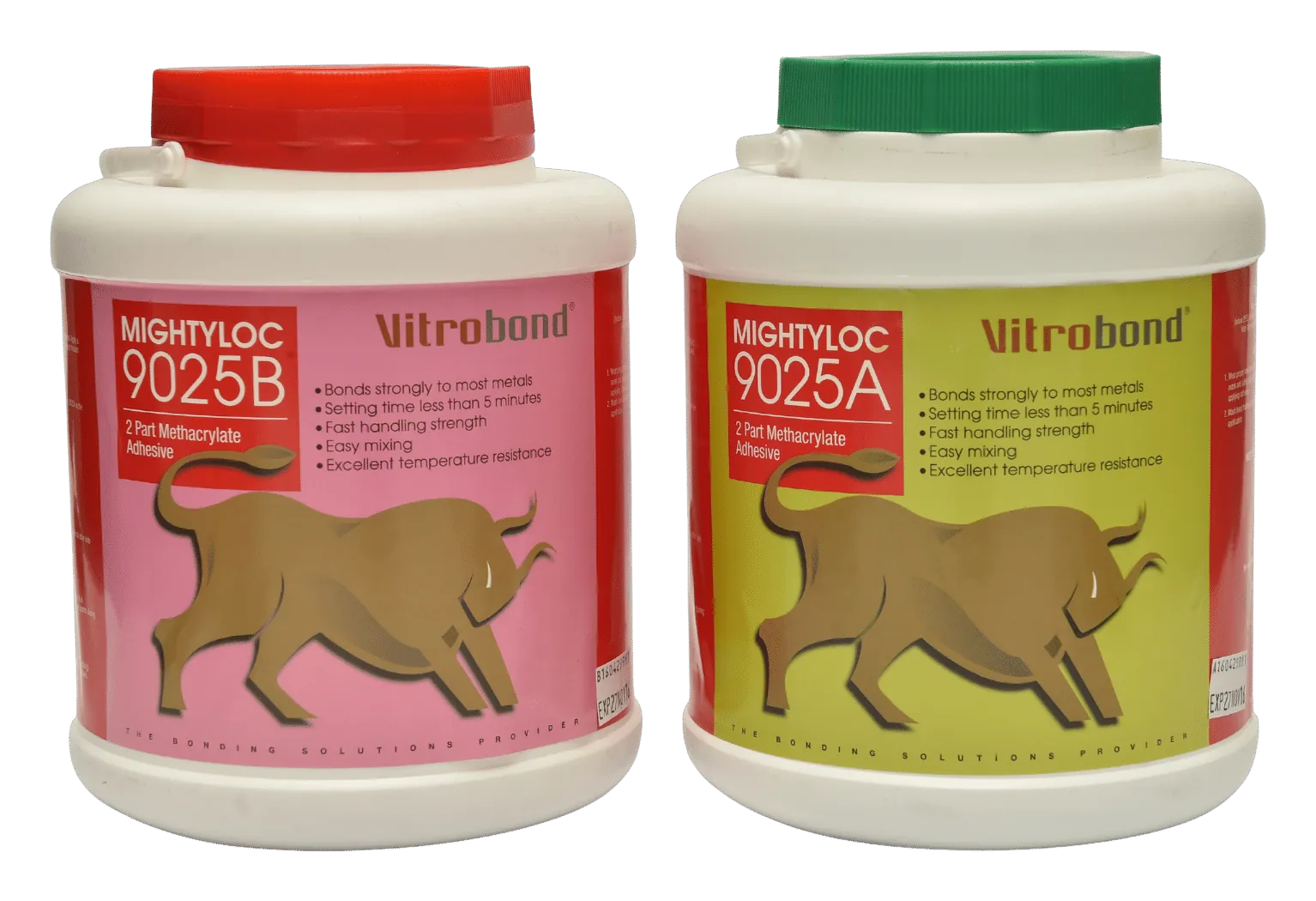
A methacrylate adhesive, often called MMA or structural acrylic, is a two-part reactive adhesive: mixing the two parts starts a free-radical cure that turns liquid methacrylate monomer into a tough, load-bearing solid at room temperature. MightyLoc offers two. MightyLoc 9025 mixes 1:1 and bonds most metals, with a shear strength of 86 kg/cm² (PSB tested to ASTM D1002), a pot life of about 3 minutes at 25 °C and full cure in 24 hours. Taftbond Solid Surface Adhesive mixes 10:1 through a static mixer and makes colour-matched seams in solid surface, quartz and natural stone. Both are on the methacrylate adhesives page.
What is a methacrylate adhesive?
A methacrylate adhesive is a reactive adhesive built on methacrylate monomers, of which methyl methacrylate (MMA) is the best known. As it cures, the monomer joins into long polymer chains and the joint becomes a solid plastic bonded to both faces. Toughened rather than glass-hard, the class is known for good peel and impact resistance.
The MightyLoc 9025 datasheet describes a two-component methyl methacrylate (MMA) adhesive for metal bonding, replacing mechanical fastening such as riveting and tack welding, with excellent impact, vibration and temperature resistance. The Taftbond Solid Surface Adhesive datasheet describes a two-component, 100% reactive, toughened structural methacrylate for the solid surface industry. “100% reactive” means there is no solvent or water to evaporate, so the joint cures through its depth.
MightyLoc’s Taftlock threadlockers are methacrylate esters too, but one-part products that cure when air is shut out between threads (what is threadlocker). UV-cure acrylics such as MightyLoc Krystal cure under light (what is UV adhesive). This guide covers the two-part grades.
How does a methacrylate adhesive cure?
A two-part methacrylate cures by free-radical addition polymerisation. One part carries an initiator, commonly a peroxide; the other carries an accelerator. When they meet they produce free radicals, and each radical starts a chain reaction that adds monomer molecules until the chains are long and linked enough to form a solid. MightyLoc’s full data sheet for Taftbond Solid Surface Adhesive (July 2023 issue, available from MightyLoc) states the split: component A contains methyl methacrylate monomer and activator component B contains peroxide.
- Ratio and mix decide the cure. MightyLoc 9025 mixes 1:1 by weight and by volume, and its datasheet warns that an uneven mix ratio may interfere with proper curing. Taftbond Solid Surface Adhesive mixes 10 parts adhesive to 1 part activator, by weight and by volume; the cartridge or meter-mix equipment sets the ratio, and a static mixer blends the two parts as they are dispensed.
- The cure makes heat, and heat speeds the cure. A thick mass heats itself and cures faster. The full Taftbond Solid Surface Adhesive data sheet warns that masses more than about 12 mm (half an inch) thick can exceed 121 °C and give off harmful, flammable vapours. MightyLoc 9025’s times are given at 25 °C, and the Taftbond Solid Surface Adhesive datasheet states no temperature for its times, so a hotter workshop or a large mixed batch leaves less working time than the figures below.
The full Taftbond Solid Surface Adhesive data sheet defines the stages of cure; here they are with each grade’s times:
- Working time (pot life)
- How long the mix stays fluid and bondable. MightyLoc 9025: about 3 minutes at 25 °C. Taftbond Solid Surface Adhesive: 10 to 15 minutes.
- Fixture time (set to touch)
- When the bond allows careful movement or unclamping. MightyLoc 9025: set to touch about 15 minutes; keep clamped 15 minutes or more. Taftbond Solid Surface Adhesive: 20 to 30 minutes.
- Functional cure
- Strong enough for careful handling and further work, not yet for service load. Taftbond Solid Surface Adhesive: 1 to 3 hours; its datasheet asks for full strength before any service load.
- Full cure
- 24 hours for both grades.
Once mixed, the cure needs no heat, light or air exclusion, unlike a cyanoacrylate such as MightyLoc Ninja 108 (surface moisture, gaps up to 0.1 mm) or an anaerobic such as MightyLoc Taftlock (close-fitting metal, air shut out).
What does methacrylate adhesive bond, and what does it not?
A grade bonds only what its datasheet names, and MightyLoc’s two grades do not overlap.
MightyLoc 9025 is formulated for metal. Its datasheet names mild steel, galvanised metal, stainless steel, aluminium and magnets. Its typical uses are elevator stiffeners, cladding and facade panels, transformer ferrite cores, speaker magnets and metal fixtures that need long-term durability. MightyLoc’s General Brochure adds fibreglass and composite fixtures. Because it cures cold, 9025 joins sheet metal and dissimilar metals without the heat distortion of a weld; see the metal fabrication and signage pages and adhesives for bonding metal.
Taftbond Solid Surface Adhesive is formulated for stone and solid surface. Its datasheet names laminations and seams in solid surface (such as Corian, HiMacs, Staron and Avonite), quartz surfaces (such as Silestone, Caesarstone and Cambria) and natural stone such as granite and soapstone. It is colour matched, UV stable and self-levelling, so a worktop seam is close to invisible. See the construction page.
Where MightyLoc names no methacrylate, do not assume one:
- Plastics and wood with MightyLoc 9025. No MightyLoc document names them. For most plastics and rubbers MightyLoc documents Ninja 108, and the Krystal UV adhesives where light can reach the bond line. Low-surface-energy plastics such as polyethylene, polypropylene and PTFE are hard to bond with any adhesive; the Ninja 108 datasheet says they need a primer, so ask MightyLoc first.
- Metals not on the 9025 list, such as copper and brass. Trial the bond and ask MightyLoc first.
- Joints that must stay elastic. A toughened methacrylate is tough, not rubbery. Large, repeated movement calls for an elastic adhesive sealant such as an MS polymer.
When should you ask MightyLoc before bonding?
The 9025 datasheet lists cladding and facade panels among its uses, but a safety-critical bond is not a catalogue choice. Building facades, vehicle chassis and rail bogies, ship hulls, lifting points, overhead work and joints under pressure follow the specification of the facade engineer, vehicle builder or naval architect and, where it applies, classification-society approval.
MightyLoc publishes no sea-water or immersion data for 9025, no food-contact or potable-water approval and no fatigue or creep data for either grade. The full Taftbond Solid Surface Adhesive data sheet says its figures are not for design purposes. Send MightyLoc the joint design, loads and service conditions before you specify, and test the actual joint. The welds to bonds article covers the design side.
What are the strengths and limits of methacrylate adhesive?
Strength. The MightyLoc 9025 datasheet gives a shear strength of 86 kg/cm² (about 8.4 MPa), PSB tested to ASTM D1002, the lap shear test for bonded metal specimens; the 9025 brochure gives 8.5 N/mm² to the same standard. ASTM D1002 is a comparison test on a standard single-lap specimen, not a design value, and the test metal is not stated, so test your own joint. The Taftbond Solid Surface Adhesive datasheet lists bond strengths without a test method; ask MightyLoc for the basis before designing to them.
Temperature. MightyLoc 9025 is rated -40 to 100 °C continuous and 150 °C intermittent, from the 9025 brochure, which does not say how long “intermittent” may last. Taftbond Solid Surface Adhesive is rated -34 to 121 °C. Strength falls as temperature rises and no strength-at-temperature data is published, so test a joint near its limit at its working temperature. A powder-coating bake usually runs above 150 °C, so bond 9025 after coating.
Upper service temperature. MightyLoc 9025 figures from the MightyLoc 9025 brochure, which does not define how long intermittent may last.
Gap. Taftbond Solid Surface Adhesive has a recommended bond line of 0.05 to 1.00 mm, and the full data sheet warns against clamping so hard that the bond line is starved. MightyLoc publishes no gap figure for 9025; for a joint that cannot be held close, ask MightyLoc.
Weather and chemicals. The 9025 datasheet lists excellent weather durability and the Taftbond Solid Surface Adhesive datasheet describes UV stability. Neither gives chemical-resistance figures; for fuels, solvents or immersion, ask MightyLoc.
How do you choose a MightyLoc methacrylate grade?
Choose by substrate first.
| Property | MightyLoc 9025 | Taftbond Solid Surface Adhesive |
|---|---|---|
| Made for | Mild steel, galvanised metal, stainless steel, aluminium and magnets | Seams and laminations in solid surface, quartz and natural stone |
| Mix ratio | 1:1 by weight and volume | 10:1 (adhesive to activator) by weight and volume |
| Working time (pot life) | About 3 minutes at 25 °C | 10 to 15 minutes |
| Fixture time | About 15 minutes (set to touch); clamp 15 minutes or more | 20 to 30 minutes |
| Full cure | 24 hours | 24 hours (functional cure 1 to 3 hours) |
| Service temperature | -40 to 100 °C continuous, 150 °C intermittent | -34 to 121 °C |
| Strength | 86 kg/cm² shear (PSB tested, ASTM D1002) | Test method not stated |
| Bond line | Not published | 0.05 to 1.00 mm |
| Shelf life | 4 months at 25 °C | Adhesive 1 year, activator 9 months, from shipment, stored at 13 to 24 °C |
| Packs | 200 g, 2 kg and 5 kg sets | Cartridge |
Values from each grade's datasheet. For MightyLoc 9025, the pot life, shelf life and service temperature are the MightyLoc 9025 brochure figures, which the 9025 datasheet shows with a note. Confirm on the current datasheet before production use.
The finder below asks what you are bonding, whether the joint is safety-critical and whether it ever runs above 100 °C.
What are you bonding?
Is the joint safety-critical: a facade, vehicle chassis or bogie, ship hull, lifting point, overhead or under pressure?
Will the joint go above 100 °C at any time, or through a powder-coating bake?
Metal: MightyLoc 9025
Solid surface and stone: Taftbond Solid Surface Adhesive
MightyLoc’s other two-part structural option is its five-minute epoxy; the methacrylate or epoxy comparison sets the two side by side.
How do you use a methacrylate adhesive well?
- Prepare the surfaces. For MightyLoc 9025, abrade the faces and clean them thoroughly with isopropyl alcohol (IPA) or acetone, free of dust, dirt and grease; never use an oil-based cleaner such as turpentine or paint thinner. For Taftbond Solid Surface Adhesive, the surfaces must be clean, dry, free of dust and grease and lightly abraded immediately before bonding. Do not skip preparation. The surface preparation guide gives the order.
- Dry-fit before you mix. With about 3 minutes of working time for 9025, have the parts aligned and the clamps ready first.
- Mix to the ratio. For 9025, apply equal amounts of Part A and Part B onto the bond area and mix evenly until no green or red streak remains. For Taftbond Solid Surface Adhesive, purge the mixer until the bead is uniform in colour; if the cartridge is ageing, let that purge cure to confirm it.
- Fill and clamp straight away. Apply enough adhesive to fill the gap, with a little squeeze-out at the edges. Clamp 9025 parts immediately and keep them clamped for 15 minutes or more. Secure Solid Surface seams against movement without starving the bond line, and test the squeeze-out for fingernail hardness before unclamping.
- Clean up while wet. Wipe excess Taftbond Solid Surface Adhesive away with an organic solvent; once cured, it needs soaking in a strong solvent or paint remover.
- Load after full cure. Allow 24 hours and let the bond reach full strength before service load. The cure-time guide sets these times beside MightyLoc’s other chemistries.
How should methacrylate adhesive be handled and stored?
Methyl methacrylate vapour is harmful and flammable; read the safety data sheet first. The 9025 datasheet asks for impervious gloves, goggles and a respiratory mask, with no open flame nearby, and the 9025 brochure warns that it is harmful if inhaled or swallowed, and that prolonged or repeated skin contact may cause irritation and allergic skin reactions, so keep the mix off bare skin. The full Taftbond Solid Surface Adhesive data sheet asks for a well-ventilated area, closed containers and storage away from heat, open flames and sparks.
- MightyLoc 9025: store in the original containers in a cool, dry area at 15 to 25 °C, away from direct sunlight; shelf life is 4 months at 25 °C. Never pour unused product back into the container.
- Taftbond Solid Surface Adhesive: shelf life is 1 year for the adhesive and 9 months for the activator, from shipment, stored between 13 and 24 °C. Activator kept above about 38 °C for long periods quickly loses reactivity. Refrigeration at about 7 to 13 °C extends shelf life; never freeze.
In Singapore, that means an air-conditioned store.
Methacrylate adhesive: questions engineers ask
Check the mix first: an uneven ratio or incomplete mix leaves parts of the bond line under-cured, as the 9025 datasheet warns. With Taftbond Solid Surface Adhesive, also check the activator's age and storage, since it keeps 9 months and loses reactivity if stored above about 38 °C.
MightyLoc 9025 gives about 3 minutes of working time at 25 °C, and heat speeds the cure, so a warm workshop or a large batch shortens it.
No MightyLoc document names plastics or wood for 9025; the General Brochure names fibreglass and composite fixtures. For solid surface, quartz and natural stone, use Taftbond Solid Surface Adhesive.
The 9025 datasheet presents it as a replacement for riveting and tack welding in metal bonding. A bonded joint spreads load over its whole area, so it needs a joint designed for adhesive. Where the joint is safety-critical, follow the designer's specification and ask MightyLoc.
Not on a datasheet alone. These joints follow the naval architect's, vehicle builder's or facade engineer's specification, with classification-society approval where it applies, and MightyLoc publishes no sea-water or immersion data for 9025. Send MightyLoc the joint design and loads first.
Equipment that pumps both parts at the set ratio into a static mixer. For it, the full Taftbond Solid Surface Adhesive data sheet requires wetted metal parts of stainless steel or aluminium, no contact with copper, zinc, brass or their alloys and seals of PTFE or UHMW polyethylene.
No. High molecular weight methacrylate (HMWM) usually means a low-viscosity resin poured onto concrete decks and slabs to seal cracks. It is a different product, and MightyLoc does not list one.
Neither is simply stronger; they balance toughness, rigidity and gap fill differently. The methacrylate or epoxy comparison sets them side by side for metal.
Samples, datasheets and where to buy
- Request a sample. The sample form lists MightyLoc 9025 and Taftbond Solid Surface Adhesive.
- Read the datasheet. MightyLoc 9025 and Taftbond Solid Surface Adhesive datasheets are open to read and download, with no login.
- Talk to the team. Send your substrates, joint design and service conditions through the contact form (choose “Technical support”), or call +65 6766 7191.
- Where to buy. Singapore: MightyLoc, 1 Bukit Batok Crescent, #05-40 WCEGA Plaza, Singapore 658064. Elsewhere: MightyLoc is supplied from Singapore, with export reach across South East Asia, the India sub-continent and the Middle East; ask the Singapore team.
- Read on. The MightyLoc 9025 deep-dive for 9025 in metal assemblies, the methacrylate adhesives page, the cure-time guide and the service-temperature guide.