
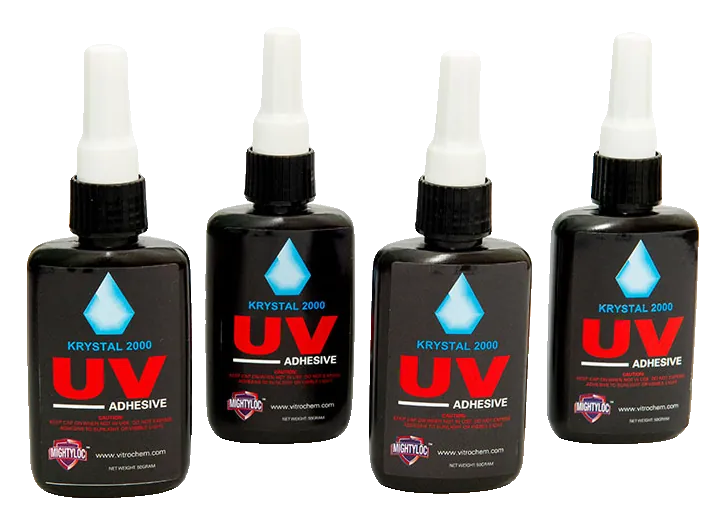
Choose a UV-cure adhesive when at least one substrate transmits light to the bond line, the lamp can reach the joint, and a water-clear bond matters. The cure happens on demand in seconds under suitable light. For glass and clear plastics the Krystal range suits these jobs. Shadowed areas do not cure, so check that the lamp reaches the whole bond line, and confirm each grade on its TDS.
Cure time and refractive index from the Krystal 1000 / 2000 / 3000 TDS. Shadowed areas do not cure; the lamp must reach the bond line.
紫外线固化胶粘剂适用于哪些场合?
紫外线固化胶粘剂为单组分产品,在未受到适当光照之前保持液态,随后按需固化。在适当灯具照射下,固化约在 10 至 15 秒内完成(参见技术数据表),因此可精确控制粘接固化的时机。这使其非常适用于玻璃粘接、显示屏及工艺品组装,以及任何对外观有要求的透明接缝。
The defining requirement is light at the bond line. Because the adhesive only cures where light reaches it, at least one of the two substrates usually has to transmit light, such as glass or a clear plastic. The cured bond is water-clear, which is why these adhesives are common where the joint is visible. The MightyLoc UV-cure range is Krystal 1000 (for plastics such as ABS, PC and acrylic), Krystal 2000, Krystal 3000, Krystal 4000 (a low-viscosity grade for glass face-to-face and T-type joints, which wicks in for a clean edge line) and Krystal 5000 (for bonding glass to glass and glass to stainless steel); see each grade’s TDS in the TDS library for per-grade differences.
| 性能项目 | 紫外线固化(Krystal 系列) | 氰基丙烯酸酯 | 双组分反应型(结构丙烯酸酯/环氧树脂) |
|---|---|---|---|
| 固化触发方式 | 粘接界面处有适当光线 | 微量表面水分 | 混合两组分 |
| 固化速度 | 按需固化,灯照数秒内完成 | 快速,数秒内 | 数分钟至过夜,因型号而异 |
| 光学透明度 | 无色透明,专为可见接缝设计 | 透明,但该类产品在可见接缝附近整体上可能出现泛白现象 | 因型号而异,多数不具备光学透明性 |
| 遮蔽区域固化能力 | No, shadowed areas stay uncured | 是,无需光照 | 是,可在整个接缝处固化 |
| 基材透光要求 | 至少一种基材须能透光 | 无要求 | 无要求 |
| 最佳适用场合 | 玻璃及透明塑料、可见接缝、显示屏组装 | 小型零件及修复的快速定位固定 | 承载或不透明接缝、间隙填充 |
关键选型因素有哪些?
紫外线固化胶粘剂的大多数选型决策取决于光线能否有效发挥作用,以及接缝中光线无法到达的部位如何处理。在确定型号之前,请逐项评估以下因素。
- 透光性:至少一种基材须能将光线传导至粘接界面。玻璃及多数透明塑料符合此要求;两种基材均不透明则不符合。
- 灯具对粘接界面的可达性:灯具须能照射到接缝处。深度内嵌或完全封闭的粘接界面难以直接固化。
- 光学透明度:紫外线固化粘接层无色透明,适用于可见接缝。在对外观有要求的玻璃粘接中,折射率可能具有重要意义;Krystal 2000 的折射率约为 1.48(参见技术数据表)。
- Shadowed areas: any region the light cannot reach stays uncured, so design the joint so the lamp reaches the whole bond line.
- 按需固化:胶粘剂在曝光前保持液态,提供开放操作时间,曝光后数秒内即可固化。这对于精确定位和高产量生产具有明显优势。
紫外线固化与其他透明及玻璃粘接方案相比如何?
在透明及玻璃粘接领域,常见的替代方案包括氰基丙烯酸酯以及结构丙烯酸酯或环氧树脂等双组分反应型胶粘剂。各类产品的固化机理不同,在可见接缝处的表现也各异。下表从定性角度对各类产品进行定位,不提供具体数值,因为准确数值取决于具体型号,应以技术数据表为准。
氰基丙烯酸酯通过与微量表面水分反应在数秒内固化,无需光照,但该类产品在可见接缝附近整体上可能出现泛白现象,且固化后较硬脆。双组分反应型胶粘剂作为一类产品整体强度较高,无需光照即可在整个接缝处固化,适用于不透明或遮蔽区域的组装,但需要混合操作且适用期较长。紫外线固化以对光照的依赖性换取洁净、按需、无色透明的粘接效果。
如何处理遮蔽区域及长期透明度问题?
Direct line of sight from the lamp to the bond line is the simplest case. Where part of the joint sits in shadow, behind an opaque rim or a thick section, that area will not cure, so design the joint so the lamp reaches it, or choose a chemistry that cures without light.
光学性能既是设计因素,也是外观因素。粘接层无色透明,折射率会影响玻璃接缝的外观效果;Krystal 2000 的折射率标注值约为 1.48(参见技术数据表)。长期透明度表现因型号而异,请勿对整个系列假设统一答案。请在技术数据表库中查阅具体型号的技术数据表,并在约一年的货架寿命期限内存放产品(参见技术数据表)。
选型方法
- 若至少一种基材为玻璃或透明塑料,且接缝为可见接缝,则来自Krystal 系列的紫外线固化胶粘剂是良好的起点,因为粘接层无色透明且可按需固化。
- 若两种基材均不透明,或粘接界面完全封闭导致灯具无法照射,应选择无需光照的固化体系,例如双组分反应型胶粘剂。
- 若需要对小型零件快速初粘且对透明度要求不高,氰基丙烯酸酯无需灯具即可在数秒内固化,但该类产品在可见接缝附近整体上可能出现泛白现象。
- If part of the joint sits in shadow, choose a chemistry that cures without light, or change the design so the lamp reaches the whole bond line.
- 根据所需外观(包括玻璃粘接的折射率)匹配具体型号,然后对照技术数据表库中该型号的技术数据表,核实固化光源要求、长期透明度及货架寿命。
常见问题
通常不适用。紫外线固化胶粘剂仅在适当光线到达粘接界面处才能固化,因此通常至少需要一种基材能够透光,例如玻璃或透明塑料。若两种基材均不透明,应选择无需光照的固化体系,例如双组分反应型胶粘剂。请在该型号的技术数据表中确认相关要求。
在适当灯具照射下,固化按需在约 10 至 15 秒内完成(参见技术数据表)。胶粘剂在曝光前保持液态,因此可获得开放操作时间以便精确定位,随后快速固化。实际固化时间取决于灯具、型号及接缝情况,请以现行技术数据表为准。
Any shadowed area, behind an opaque rim or in a deep section, will not cure. Design the joint so the lamp can reach the whole bond line, or choose a chemistry that cures without light, such as a two-part methacrylate or a cyanoacrylate.
是的,紫外线固化粘接层无色透明,因此适用于玻璃及透明塑料的可见接缝。对于玻璃粘接,折射率会影响外观效果;[Krystal 2000](/products/Krystal-2000/) 的标注折射率约为 1.48(参见技术数据表)。长期透明度因型号而异,请查阅具体型号的技术数据表,而非对整个系列假设统一答案。
货架寿命约为一年(参见技术数据表),在技术数据表规定的条件下储存效果最佳。由于该产品为光固化型,在储存和操作过程中须避免杂散光照射。请始终以您持有型号的现行技术数据表为准,确认货架寿命及储存条件。