Bonding chemistry · UV ADHESIVE
UV Adhesive
A UV-cure adhesive is a single-part adhesive that stays liquid until exposed to suitable light, then cures on demand in seconds. It needs light to reach the bond line, so at least one substrate is usually light-transmissive, and it forms water-clear bonds, which makes it common for glass and clear-plastic assemblies.
FAQ · UV ADHESIVE
Questions about UV Adhesive.
Generally no. UV-cure adhesives cure only where suitable light reaches the bond line, so at least one substrate usually has to transmit light, such as glass or clear plastic. If both parts are opaque, choose a chemistry that does not need light. Confirm the requirement on the product Technical Data Sheet.
Under a suitable lamp the cure happens on demand in roughly 10 to 15 seconds. The adhesive stays liquid until you expose it, giving open working time for precise placement before a fast set. Actual cure time depends on the lamp, the grade, and the joint, so confirm against the Technical Data Sheet.
Any area the light cannot reach, behind an opaque rim or in a deep section, will not cure from the lamp alone, so plan a secondary cure path for those regions. Designing the joint so the lamp can see most of the bond line keeps this simpler. Confirm what each grade supports on its Technical Data Sheet.
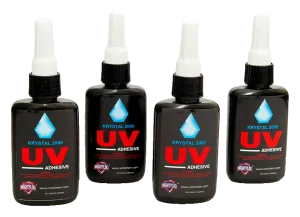
Yes, UV-cure bonds are water-clear, which is why they suit visible glass and clear-plastic joints. For glass, refractive index can affect appearance; Krystal 2000 is listed at about 1.48. Confirm clarity and the refractive index for the grade on its Technical Data Sheet.
How do UV-cure adhesives work?
A UV-cure adhesive cures only where suitable light reaches it, so the cure happens on demand the moment you switch on the lamp, in roughly 10 to 15 seconds under suitable light. Because light has to reach the bond line, at least one of the two substrates usually has to transmit light, such as glass or a clear plastic. Any area in shadow needs a secondary cure path. Confirm cure light, exposure, and shadow handling for the grade on its Technical Data Sheet.
Where are UV-cure adhesives used?
UV-cure adhesives suit glass bonding, display and craft assembly, and any visible joint where appearance matters, because the cured bond is water-clear and you control exactly when it sets. The on-demand cure gives open working time for precise placement, then a fast set for throughput. Where both parts are opaque or the bond line is fully enclosed, a chemistry that does not need light is the better fit.
How do you choose a UV-cure grade?
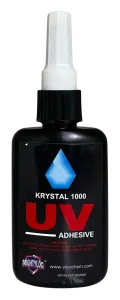
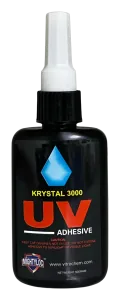
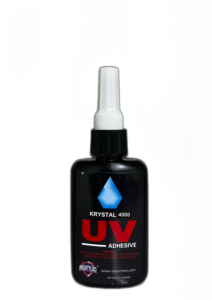
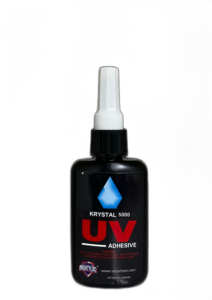
The MightyLoc UV-cure range is Krystal 1000, Krystal 2000, and Krystal 3000. Clarity and refractive index can matter when bonding glass for appearance; Krystal 2000 has a refractive index of about 1.48. Shelf life is about one year, and product should be shielded from stray light in storage. Treat differences between grades as a matter for each grade's Technical Data Sheet, and confirm cure light and clarity there.