
Bonding chemistry · 5 MINUTES EPOXY
5 Minutes Epoxy
MightyLoc 5 Minutes Epoxy products, with the substrate guidance, applications, and downloadable Technical Data Sheets your specification needs.
Products
MightyLoc 5 Minutes Epoxy products
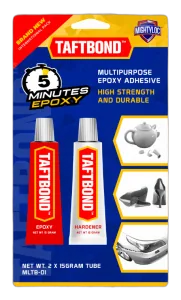
Specifications
| Product | Viscosity | Service temperature | Fixture time |
|---|---|---|---|
| Taftbond 5 Minutes Epoxy | 20-50 Pas (resin) / 20-40 Pas (hardener) | -40 to 120 °C | Gel time 4 to 5 minutes (20 g at 25°C) |
Values as published on each product page. Full Technical Data Sheets are linked there.
FAQ · 5 MINUTES EPOXY
Questions about 5 Minutes Epoxy.
Taftbond 5 Minutes Epoxy gels in four to five minutes on a 20 g mix at 25°C, with a worklife of eight to ten minutes on the same mix. Gel time is not full strength: full cure is one day at 25°C, or two hours at 60°C. Mix smaller quantities if you need longer to position the parts, because a larger mass generates more heat and sets faster.
One to one by volume, resin to hardener. An epoxy cures by reaction between the two parts, so an off-ratio mix leaves unreacted material and a weaker, softer bond. Mix until the colour is uniform with no streaks.
Taftbond 5 Minutes Epoxy is published at 80 kg/cm2 lap shear strength. Real joint strength depends on the substrates, the surface preparation and the bond area, so treat the figure as a comparison point between adhesives rather than a prediction for your joint. Confirm against the Technical Data Sheet.
Minus 40°C to 120°C. That covers most indoor and general industrial use. For sustained heat above that range, or for structural load at temperature, choose a structural methacrylate such as MightyLoc 9025 instead and confirm on its Technical Data Sheet.
It cures clear and transparent, which is why it suits visible repairs and small display work. Clarity over long outdoor exposure is not published, so if appearance matters after prolonged UV exposure, ask for the Technical Data Sheet before committing.
Thirty six months at 25°C, unopened. It is supplied as two 15 g tubes, resin and hardener.
Five minute epoxy is rigid when cured, so it is a poor choice where the joint must flex or absorb movement between dissimilar materials. For elastic bonding and sealing use an MS polymer such as TaftGrip or a polyurethane sealant such as Taftflex. For bonding that must hold structural load, use a methacrylate such as MightyLoc 9025.
Five minute epoxy is a two-component adhesive that mixes resin and hardener in equal parts and reaches handling strength in minutes rather than hours. It bonds a wide range of substrates and cures to a clear, rigid film, which makes it the usual choice for fast repairs, small fixtures and bonds that need to hold before the next assembly step.
MightyLoc supplies it as Taftbond 5 Minutes Epoxy, a 1:1 by volume system that gels in four to five minutes and reaches full cure in one day at 25°C, with a published lap shear strength of 80 kg/cm2 and a service range of -40°C to 120°C.
Where five minute epoxy fits, and where it does not
A five minute epoxy earns its place when the joint has to hold before the next step can start: a bracket that must stay put while the assembly is turned over, a repair that cannot wait a working day, a small part that would need clamping for hours under a slower system.
It is rigid when cured. That is an advantage on a stiff joint between similar materials and a disadvantage where the bond line has to absorb movement. Two materials that expand at different rates through a daily heat cycle will work against a rigid bond at its edges. For that job an elastic adhesive such as an MS polymer or a polyurethane sealant is the better choice, and for a joint that must carry structural load a methacrylate is.
Mix quantity changes the working time. An epoxy cures by reaction between its two parts and that reaction generates heat, so a larger mixed mass sets faster than a small one. Mixing less at a time is the practical way to buy yourself more placement time.