
Bonding chemistry · CONTACT ADHESIVE
Contact Adhesive
MightyLoc Contact Adhesive products, with the substrate guidance, applications, and downloadable Technical Data Sheets your specification needs.
Products
MightyLoc Contact Adhesive products
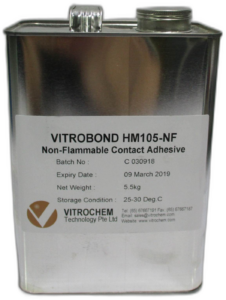
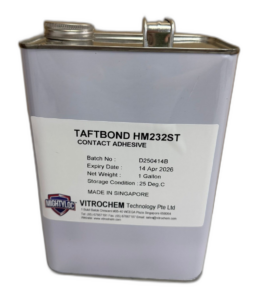
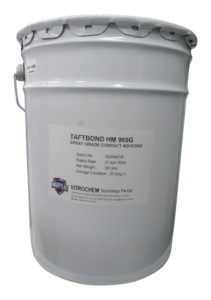
Specifications
| Product | Viscosity | Service temperature | Fixture time |
|---|---|---|---|
| Taftbond HM105NF | 4,500 cps (Brookfield Sp.2, 20 rpm, 25°C) | Tack-free 10 to 15 minutes (30°C) | |
| Taftbond HM232ST | 150-250 cps (Brookfield) | Tack-free 5 to 10 minutes (25°C) | |
| Taftbond HM969G | 80-100 cps (Brookfield, spindle 5 rpm) | 60 °C | Tack-free 5 to 10 minutes (30°C) |
Values as published on each product page. Full Technical Data Sheets are linked there.
FAQ · CONTACT ADHESIVE
Questions about Contact Adhesive.
Both surfaces are coated and left until tack-free, then brought together. The bond forms on contact under pressure instead of developing while the parts are clamped. There is very little repositioning once the surfaces meet, so alignment has to be right first time.
Tack-free time is five to ten minutes at 30°C for Taftbond HM969G, five to ten minutes at 25°C for Taftbond HM232ST, and ten to fifteen minutes at 30°C for Taftbond HM105NF. Times shift with temperature, humidity and how heavily the adhesive is applied. Singapore and the wider region sit at the warm, humid end of that range, so check the surface rather than the clock.
Choose by the constraint that matters on the job. Fire-sensitive areas such as tunnelling and hot-work zones: Taftbond HM105NF, which is non-flammable. Bonding to Styrofoam, or work where a clear glue line matters: Taftbond HM232ST, applied by brush or roller. Large panels needing fast even coverage: Taftbond HM969G, sprayable neoprene.
Taftbond HM105NF is published at 21 kGF overlap shear, steel to steel, at 24 hours, and reaches about 80 percent of strength in roughly two hours with full cure at six hours. Strength figures for HM232ST and HM969G are not published on their product pages; request the Technical Data Sheet for those two rather than assuming they match.
Taftbond HM232ST is specified as safe on Styrofoam. Many solvent-based contact adhesives attack polystyrene foam, so do not substitute another grade onto foam without confirming it on the Technical Data Sheet.
HM232ST by brush or roller. HM969G by spray. HM105NF is supplied in a 5.5 kg tin; confirm the application method on its Technical Data Sheet. Coat both faces, wait for tack-free, then join under firm even pressure.
Twelve months for all three, stored at 25°C for HM232ST and HM969G. Pack sizes are a 5.5 kg tin for HM105NF, one gallon and 18 litre for HM232ST, and a 20 litre drum for HM969G.
Contact adhesive is applied to both surfaces, left until tack-free, and then bonded on contact under pressure rather than clamped while it cures. That makes it the standard choice for large flat areas such as laminates, panels and veneers, where clamping the whole surface is impractical.
MightyLoc supplies three: Taftbond HM105NF, a non-flammable polychloroprene for fire-sensitive work; Taftbond HM232ST, a clear brush and roller grade that is safe on Styrofoam; and Taftbond HM969G, a sprayable neoprene for fast coverage over large panels.
The three Taftbond contact adhesives, compared
All three are applied to both faces, left until tack-free, then bonded on contact under pressure. They are not interchangeable: each exists to solve a different constraint, and the constraint usually decides the product before the substrate does.
| Product | Base | Tack-free time | Application | Overlap shear, steel to steel |
|---|---|---|---|---|
| Taftbond HM105NF | Polychloroprene, non-flammable | 10-15 min at 30°C | See Technical Data Sheet | 21 kGF at 24 hours |
| Taftbond HM232ST | Synthetic resin, clear | 5-10 min at 25°C | Brush or roller | Not published |
| Taftbond HM969G | Neoprene | 5-10 min at 30°C | Spray | Not published |
Choose by the constraint that governs the job. Fire-sensitive work such as tunnelling and hot-work zones: HM105NF, which is non-flammable. Bonding to Styrofoam, or work where a clear glue line matters: HM232ST, which is specified as safe on Styrofoam where many solvent-based contact adhesives are not. Large panels needing fast even coverage: HM969G. All three carry a 12-month shelf life. Strength is published for HM105NF only; request the Technical Data Sheet for the other two rather than assuming they match.
How a contact bond is different to work with
Both faces are coated and left until the adhesive is dry to the touch. The bond then forms the moment the surfaces meet under pressure, not over the hours that follow. There is very little repositioning once they touch, so alignment has to be right the first time. On a large panel that usually means working from one edge, or using slip sheets withdrawn progressively as the panel is laid down.
Tack-free time is a working window, not a fixed number. It shifts with temperature, humidity and how heavily the adhesive was applied. Singapore and the wider region sit at the warm, humid end of the range the Technical Data Sheets were written for, so the reliable method is to check the surface rather than the clock.
Pressure matters more than most users expect. The bond strength comes from intimate contact between the two adhesive films, so firm even pressure across the whole area, applied with a roller or a press rather than by hand, is what turns a contact bond into a strong one.