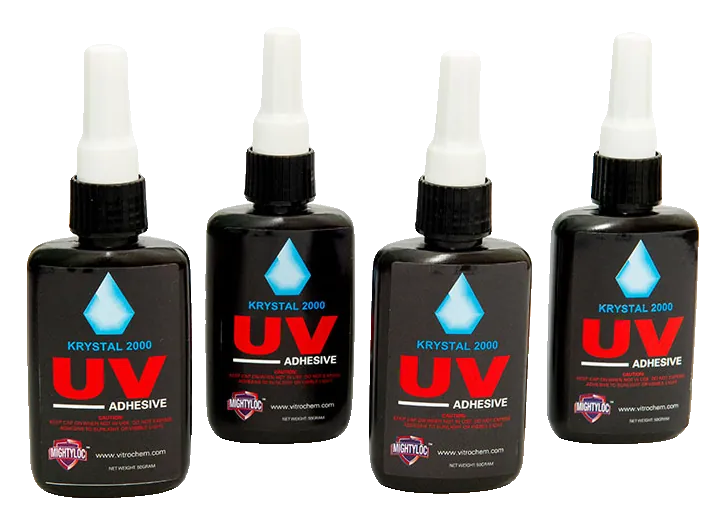
MightyLoc’s Krystal UV adhesives are one-part acrylic resins that stay liquid until their curing light reaches the joint: 365 nm UV for all five grades, and visible light for Krystal 1000 to 4000. Krystal 1000 to 4000 cure in 10 to 15 seconds under their datasheet conditions; Krystal 5000 publishes no cure time. The light has to reach the bond line, so at least one of the two parts usually has to transmit it.
UV adhesive, also called UV cure adhesive or UV glue, is cured by light at the bond line. Some UV adhesives on the market add a second cure for shadowed areas; no Krystal grade does, so with Krystal any area the light cannot reach stays uncured. This guide explains how and why it cures, what it bonds, when it is the wrong choice and what to check when a joint stays wet. The five grades and their values are compared on the UV adhesive page.
What is a UV adhesive?
It is a one-component adhesive, so there is nothing to mix; it stays workable until light reaches it. That lets you position and align the parts before you fix them. Inside the resin, a light-sensitive ingredient called a photoinitiator absorbs the light and starts the polymerisation that turns the liquid into a solid; this is how light-curing adhesives work in general, and MightyLoc’s Krystal datasheets describe the grades as photo-curing. All five Krystal datasheets list 0 % solvent content, so nothing evaporates during cure. The cured bond is clear (the datasheets call Krystal 1000 and 3000 ultra-clear and Krystal 2000 non-yellowing), which is why UV adhesive is common on glass and clear plastics.
How does UV adhesive cure, and what wavelength does it need?
Every MightyLoc Krystal datasheet gives 365 nm as the curing wavelength. Krystal 2000 and Krystal 4000 also cure under visible light at 436 nm. The Krystal 1000 and Krystal 3000 datasheets describe curing under UV or visible light but give no visible wavelength.
The light has to reach the adhesive. The lamp is held close over the joint and shines through the clear part, whether glass, acrylic or polycarbonate. Any area the light cannot reach, behind an opaque rim or in a deep section, will not cure; no Krystal grade has a second cure mechanism to finish it later. Design the joint so the lamp reaches the whole bond line, or choose a chemistry that cures without light, such as MightyLoc 9025, a two-part methacrylate for metals, or MightyLoc Ninja 108 cyanoacrylate.
What does UV adhesive bond, and what does it not bond?
MightyLoc Krystal bonds where at least one part transmits its curing light. A part can look clear and still block UV, as UV-stabilised polycarbonate and laminated glass can. By datasheet, Krystal 1000 and Krystal 3000 are made for common plastics (ABS, HIPS, PS, PC, PVC and acrylic) and Krystal 3000 also bonds glass. Krystal 2000 bonds glass, acrylic, polycarbonate, ABS and some metals; Krystal 4000 is for glass; Krystal 5000 bonds glass to glass and glass to stainless steel.
It generally does not cure between two opaque parts, because neither lets the light through; a metal-to-metal joint is the plain example. No Krystal datasheet lists polyethylene or polypropylene, and MightyLoc’s surface-preparation guide notes that these low-energy plastics usually need a primer or surface treatment. Ask before using Krystal on them.
Where is UV adhesive used?
MightyLoc lists Krystal for glass and clear-plastic assembly, including glass table tops, clear acrylic signage, trophies and plaques. MightyLoc’s pages name these jobs:
- glass furniture, display assembly and outdoor signage, with Krystal 2000;
- joints between glass, clear acrylic and polycarbonate in signs and furniture, where the join should disappear into the material;
- glass display and award work with face-to-face and T-joints, with Krystal 4000;
- glass-to-stainless-steel fittings and glass and metal display work, with Krystal 5000;
- clear sign faces that must bond without a visible glue line, and glass-to-metal joints where the bond line shows.
More on these in signage and adhesives for bonding glass.
When is UV adhesive the wrong choice?
- Neither part transmits the curing light, or the joint is enclosed. Both parts are opaque, a clear part blocks UV (UV-stabilised polycarbonate, laminated glass), or no lamp can reach the bond line. Use a chemistry that cures without light: MightyLoc 9025, a two-part methacrylate, for metals, or MightyLoc Ninja 108 cyanoacrylate for small parts that carry no structural load. For metal, the methacrylate or epoxy comparison sets out the two-part options.
- Hot joints. The Krystal datasheets give a temperature range up to 100 °C (Krystal 2000: 120 °C) without the test behind it. A joint that runs hotter needs another chemistry, and near the limit, test the joint at its working temperature; the service-temperature guide ranks every MightyLoc product by its upper limit.
- A metal frame on a clear face that moves with heat. Where the two parts expand at different rates, MightyLoc’s signage guidance uses a MightyLoc AFT acrylic foam tape, whose foam core takes up the movement; Krystal is kept for clear-to-clear and glass-to-metal joints. Clear AFT 3100CF is listed for metal, aluminium, stainless steel, PMMA and glass.
- Joints that must flex or seal. For flexible, sealed joints on glass, use MightyLoc Taftflex 6292, a polyurethane sealant that adheres to glass without primer, or MightyLoc TaftGrip MS polymer, listed for automotive window glass glazing, rather than a rigid bond.
- Load you cannot verify. Three datasheets give a strength: a tensile strength of 108 kg/cm² (about 10.6 MPa), acrylic to acrylic, for Krystal 1000 and Krystal 3000; a shear strength of 131 kg/cm² (about 12.8 MPa) glass to stainless steel and 118 kg/cm² (about 11.6 MPa) glass to glass for Krystal 5000. None states the test method or cure condition, and Krystal 2000 and Krystal 4000 publish no strength. For a load-bearing joint, test bonded samples of your own parts, for example as single-lap shear coupons of your own substrates and lamp set-up (ISO 4587 describes the method for rigid substrates).
- A quick tack where clarity does not matter. MightyLoc Ninja 108 cyanoacrylate fixtures in 3 to 20 seconds (at 21 °C, depending on the substrate) without a lamp, though cyanoacrylate can whiten near a visible joint. The UV-glass guide compares the two, and the cyanoacrylate page gives its limits.
Which Krystal grade fits which job?
Every MightyLoc Krystal grade cures under light, so the choice turns on viscosity (at 25 °C, in cps, which equal mPa·s), the materials each bonds and the heat the joint sees. As a starting point:
- Plastics such as ABS, PC, PVC and acrylic: MightyLoc Krystal 1000 (650 to 1050 cps), or Krystal 3000 (5 to 15 cps) where the joint is close-fitting and the adhesive should wick in; Krystal 3000 also bonds glass.
- Glass where a thin grade would run, or a joint that must not yellow: Krystal 2000 (5000 to 7000 cps), the grade least likely to run on a vertical joint, with a temperature range to 120 °C and stated not to yellow at 80 °C.
- Glass face-to-face and T-joints: Krystal 4000 (45 to 65 cps), which can be run along the edge after assembly and wicks in for a clean edge line.
- Glass to glass and glass to stainless steel: Krystal 5000 (80 to 130 cps), with capillary penetration for seamless edge bonding between glass.
The datasheet figures for the five grades, side by side:
| Viscosity at 25 °C, cps (S14 spindle, 100 rpm) | Cure data | Strength (method not stated) | ||||
|---|---|---|---|---|---|---|
| Plastics: ABS, HIPS, PS, PC, PVC, acrylic | Krystal 1000 | 650 to 1050 | 365 nm UV, or visible | 10 to 15 s, 1,500 to 3,000 mJ/cm² | -40 °C to 100 °C | Tensile 108 kg/cm² (about 10.6 MPa), acrylic to acrylic |
| Close-fitting plastic or glass joint, wicked in | Krystal 3000 | 5 to 15 | 365 nm UV, or visible | 10 to 15 s, 1,500 to 3,000 mJ/cm² | -40 °C to 100 °C | Tensile 108 kg/cm² (about 10.6 MPa), acrylic to acrylic |
| Glass, acrylic, PC, ABS, some metals; must not run or yellow | Krystal 2000 | 5000 to 7000 | 365 nm UV or 436 nm visible | 10 to 15 s, 1,500 to 3,000 mJ/cm² | -40 °C to 120 °C | Not published |
| Glass face-to-face and T-joints, applied by penetration | Krystal 4000 | 45 to 65 | 365 nm UV or 436 nm visible | 10 to 15 s, 1,500 to 3,000 mJ/cm² | -40 °C to 100 °C | Not published |
| Glass to glass, glass to stainless steel | Krystal 5000 | 80 to 130 | 365 nm UV, above 50 mW/cm² | No cure time published | -40 °C to 100 °C | Shear 131 kg/cm² (about 12.8 MPa) glass to stainless steel; 118 kg/cm² (about 11.6 MPa) glass to glass |
The UV adhesive page compares the five grades, and each grade’s datasheet is linked from its product page.
How do you apply UV adhesive?
- Clean and dry both surfaces. Do not degrease acrylic or polycarbonate with acetone or other ketones, which can craze them; ask MightyLoc which cleaner to use.
- Apply a thin film to one surface and close the parts; keep it thin enough that only a little squeezes out.
- Align the parts while the film is still wet.
- Wipe the excess from the edges before you cure.
- Cure with 365 nm UV (Krystal 2000 and 4000 also cure under visible light at 436 nm) shone through the part that transmits it; time and lamp are in the next section.
For a glass face-to-face or T-joint, a thin grade such as Krystal 4000 or Krystal 5000 can be applied by penetration: position the parts first, run the adhesive along the edge and let it wick into the joint, then apply the light. This gives a clean glue line at the edge.
How long does UV adhesive take to cure, and what lamp do you need?
The MightyLoc datasheets for Krystal 1000 to 4000 give a recommended cure time of 10 to 15 seconds at 365 nm and 1,500 to 3,000 mJ/cm². The Krystal 5000 datasheet gives a UV intensity above 50 mW/cm² at 365 nm and no cure time, so establish its exposure on your own parts.
Treat any time as a guide: the lamp, the grade and the joint all change it. Cure depends on UV intensity and dose, not only on exposure time; a figure in mJ/cm² is a dose, the irradiance in mW/cm² multiplied by the exposure time in seconds. For production work MightyLoc recommends a calibrated UV lamp, so every joint receives a consistent dose. It also recommends testing cure completeness on your own parts before a production run. The cure-time guide sets the Krystal times beside MightyLoc’s other chemistries.
Measure the irradiance at the bond line with a UV radiometer, through the part the light passes through. Check it regularly: lamp output falls with age and with distance from the joint. Shield the lamp and protect operators’ eyes and skin from UV, as the lamp maker instructs.
Why does UV adhesive need dark, cool storage?
Because MightyLoc Krystal cures on light, stray light can start a premature cure. That is why it comes in anti-UV bottles, and why an opened bottle should also be kept out of the light. Heat is the other risk the datasheets name: store unopened bottles in a cool, dry place at 15 to 25 °C, away from high heat and direct light. Each grade has a one-year shelf life in its original, unopened container stored that way. Pack sizes for each grade are on its product page and datasheet. Safety data sheets are available on request.
Why is my UV adhesive not curing?
Work through these checks, in this order:
Not if both parts are opaque, the joint is enclosed, or the clear part blocks UV, as UV-stabilised polycarbonate and laminated glass can. Check the light through the actual part, or trial a bond.
Areas behind an opaque rim or in a deep section stay uncured, and no MightyLoc Krystal grade cures them later. Change the design so the lamp reaches the whole bond line.
Without enough UV intensity the cure will be incomplete. Cure depends on lamp intensity and total dose, not only on exposure time.
The datasheets specify 365 nm, and Krystal 2000 and 4000 also cure at 436 nm. Many LED lamps emit a narrow band at another wavelength, such as 385 or 405 nm; that is not a datasheet condition, so trial it on your parts or ask MightyLoc first.
Stray light can start a premature cure in the bottle; check the product is within the shelf life on its datasheet.
A thin tacky film on adhesive left exposed to air after cure is typical of acrylic UV adhesives, because oxygen slows the cure at the surface; the bond line between the parts is not affected. Wiping the excess before cure, as the directions say, avoids it.
If the adhesive cures but the joint lets go, look at the surface first: most adhesive failures start before the adhesive goes on. MightyLoc’s guide to surface preparation sets out the routine.
Samples, datasheets and where to buy
- Request a sample. The sample form lists all five MightyLoc Krystal grades, and you can ask for several at once; say what you are bonding in the notes.
- Read the datasheet for your grade. Datasheets for Krystal 1000, Krystal 2000, Krystal 3000, Krystal 4000 and Krystal 5000 are open to read and download, with no login.
- Talk to the team. Tell MightyLoc your substrates, light source and service conditions through the contact form (choose “Technical support”), or call +65 6766 7191.
- Where to buy. Singapore: MightyLoc, 1 Bukit Batok Crescent, #05-40 WCEGA Plaza, Singapore 658064. Elsewhere: MightyLoc is supplied from Singapore, with export reach across South East Asia, the India sub-continent and the Middle East; ask the Singapore team.
- Read on. The UV adhesive page compares the five grades; the UV-glass guide covers light access and clarity on glass; adhesives for bonding glass sets Krystal beside tapes and sealants.